How did you become involved with the GIFT project?
Seven years ago, Anders Sundnes Løvlie, now Principal Investigator of the GIFT project, and I participated in the making of Random Friends, a hybrid street game, that was played simultaneously in Trondheim, Norway, and Belgrade, Serbia. It was a game about two countries in Northern and Southern Europe that do not belong to the European Union. So the first contact between Anders and me was as game designers.
Random Friends was a so-called ‘critical game’ that explored our attitudes and understanding of the European Union from an external perspective. Several years later, Anders invited me to join the GIFT consortium and here we are – participating together in the EU H2020 project GIFT, this time from a different perspective. I find this is quite a symbolic circle – where the EU acts either as a conceptual or administrative frame for our research.
Can you tell me a little about ‘appropriation’ and how it has impacted your work?
Readers of the other articles in this series will be familiar with how the GIFT app is based on the creative use of gifting, i.e., giving... However, we’ve also been working on projects based on taking. By ‘taking’ I mean – appropriation, as a method of personalisation and transformation of artworks. What do we take with us from a museum visit? Is a museum object confined to a museum or exhibition context forever, or can it be decontextualised and made ‘mine’ by personalising it? Can it be ‘mine’ in a much deeper and more profound sense than the concept of material and legal ownership? When considering appropriation we tend to raise many questions... and so are trying to provide some answers.
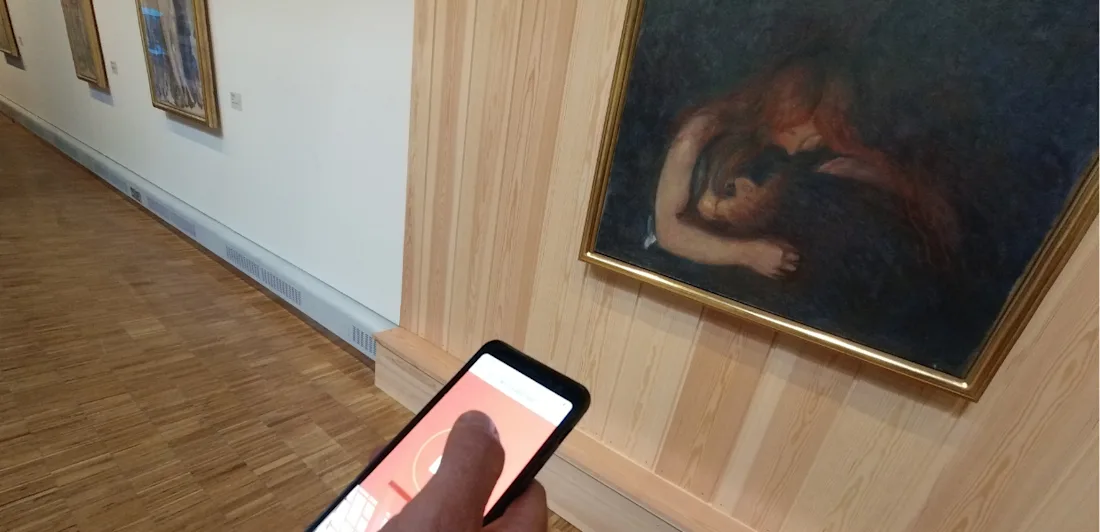
Unlike well-known appropriation models where artists re-use existing objects and materials to create new artwork, we have focused on appropriation carried out by visitors. We have tested different personalisation methods and techniques to make a museum visit a strong emotional experience, where museum objects are perceived as something that belongs to our personal and intimate emotional space. In this sense appropriation is not understood as an artistic method or cultural policy but as an approach that connects our emotions and experiences with the museum exhibition. We developed a special museum web application called Sensitive Pictures to enable visitors to establish such connections.
Sensitive Pictures creates an intimate emotional museum experience by leading visitors on a journey through their personal memories, hopes and thoughts. Using the app, visitors choose which emotions they would like to explore… (e.g. love, passion, nostalgia, etc.). Each emotion is connected to a different museum object and evoked by specially-designed audio content to connect museum stories with personal memories. During the experience, visitors think about their feelings and try to understand and describe them. As a result, each visitor takes their own private path through a museum collection based on their emotions, perceiving museum objects as milestones in the personal journey. Sensitive Pictures highlights the uniqueness of our encounters with art, which are subject to our own experiences, knowledge and emotions.
We also brought an educational aspect to Sensitive Pictures by providing experts’ insights about every museum object. This part of the app is also designed to fit into the emotional context of the whole experience.
Where can we experience Sensitive Pictures for ourselves?
We are currently testing Sensitive Pictures in the Munch Museum, Oslo. The Munch Museum is a perfect lab environment for this kind of research – dedicated to the oeuvre of a man who thought that his paintings were the equivalent of diary pages, making them extremely personal and thus universal. Additionally, the museum was open to initiatives, research and learning about new methods of visitors’ engagement - which has been very important in the development of this experiment.
How do you see this kind of technology connecting various art forms in the future?
The National Museum had a vision and a modern strategic approach to engage and expand their audience through new and innovative channels. And Kombank Dvorana was eager to join forces with the National Museum to promote culture. Therefore it was a win-win situation. It’s very important to create partnerships that open new communication channels, so it’s not just about technology - it’s about mutual understanding and partnership. Technology comes after that.
The #OneMinuteMuseum project is a highly evocative and persuasive guided fantasy that takes viewers on a journey through their imagination. With an educational part as well, it strikes a good balance between emotion and information. Although we’ve really just begun working with this format, it’s obvious that the possibilities are literally endless. By connecting museums and cinemas (and television and other media), and making strong emotional, poetic experiences inspired by museum objects, we’re able to produce a very special kind of content with great media potential. That potential is still to be explored and developed, which is an extremely exciting opportunity for us.
GIFT @ Europeana 2019
Bogdan will be joining other members of the GIFT project at Europeana 2019 and you can hear all about the project so far, the research underpinning it and test some of the tools yourself at GIFT @ Europeana 2019. Book your ticket and select GIFT @ Europeana 2019 to guarantee your seat.