The hackathon marked the culmination of the Twin it! Part II campaign, bringing together cultural heritage professionals, developers and students from across the world to explore new ways of using and reimagining 3D cultural heritage data. Participants developed creative projects that showcased the potential of 3D data in supporting access, engagement, tourism and education.
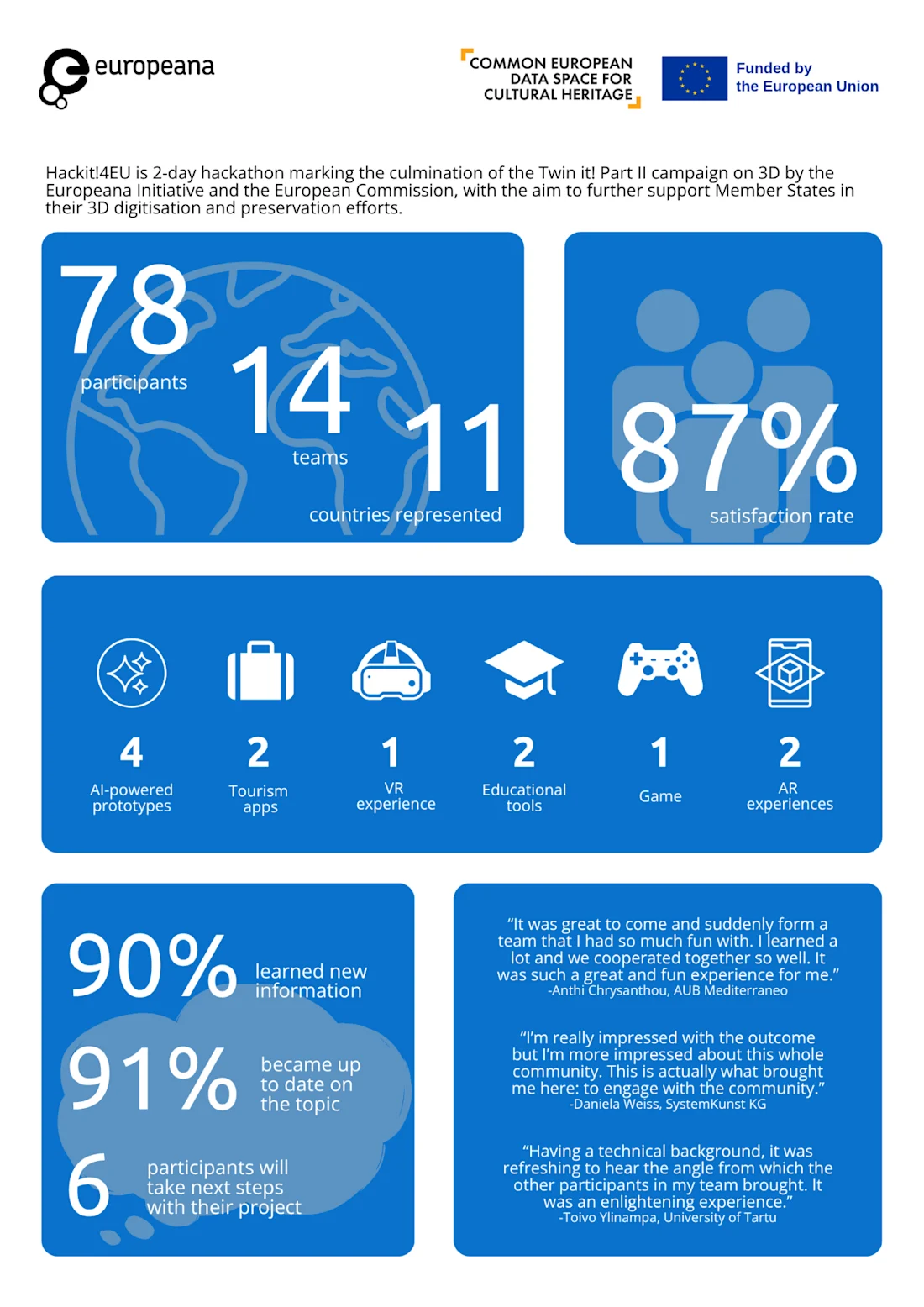
Two separate project tracks were run in parallel during the hackathon: a Professionals Track and a School Group Track. Stay tuned for more news soon on the School Group Track.
The winning project from the Professionals Track stood out for its creativity, impact and potential for scalability, among a strong field of outstanding projects. Below you can find a short description of all other participating projects, each showcasing the powerful reuse potential of 3D cultural heritage in a different use case.
Winning Team
The first prize was awarded to the team named The Pixelated Past for their project, 'Guardians of the Island Treasures', a history-based game that encourages active learning for ages 10-15. The castle treasure hunt game brings users on a journey to 10 historic castles across Cyprus, to recover lost heritage objects and restore them to their digital collection. While the current demo is based on 2D images, the intention is that the user can explore the 3D model of each site while searching for the lost heritage objects.
'Working with my team was a wonderful experience. Even though we met for the first time at the hackathon, we quickly found a shared vision and enjoyed working together. I am very grateful to my teammates for helping make this such a memorable experience.' - Eleonora Dottorini
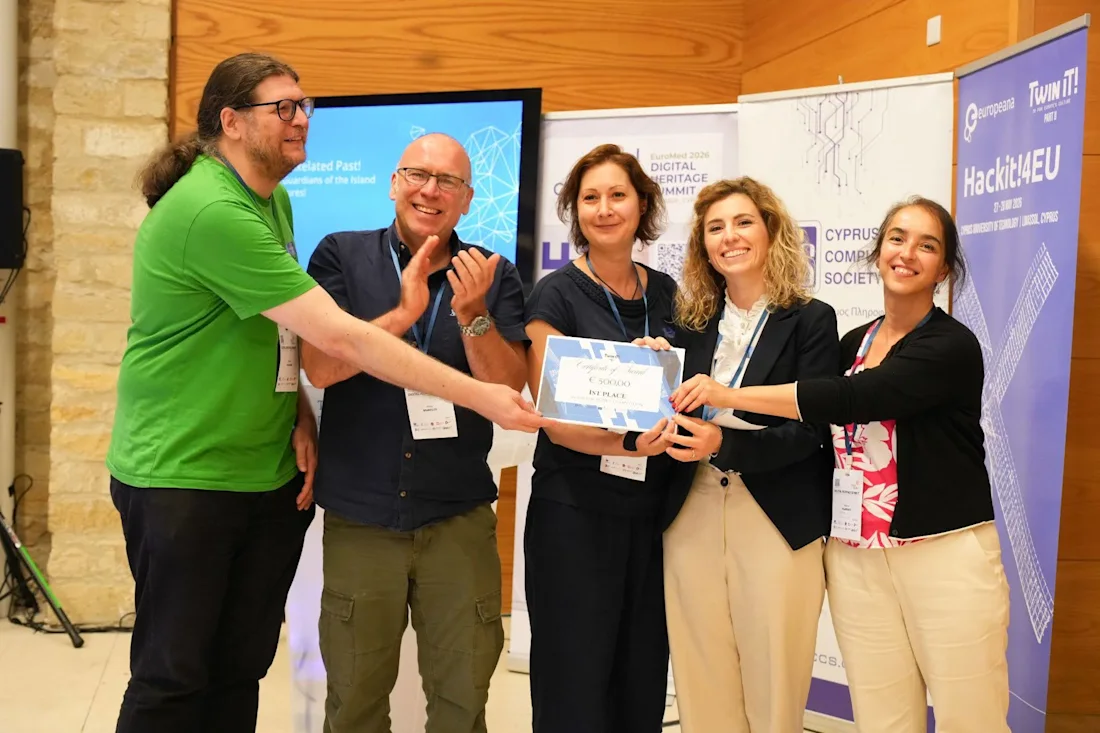
The project was created by Andy Beardsley, Eleonora Dottorini, Robert Faulmann, Gianina Sontea, and Márcia Vilarigues.
Check out the short demo video of the game below created by the team, or directly test the demo yourself. Please note that the link and/or demo might not be maintained long-term and may therefore cease functioning in the future.
Biographies of the Winning Team
Andy Beardsley MRICS is Managing Director of Terra Measurement Ltd, and a Chartered Geospatial Surveyor with over 33 years’ experience. He specialises in 3D geospatial survey, heritage documentation and digital conservation. He is a Society for the Protection of Ancient Buildings (SPAB) Specialist and Guardian, and advocates for best-practice digital heritage data.
Eleonora Dottorini is an architect, building engineer and photographer. She is a PhD candidate at the Department of Civil and Environmental Engineering of the University of Perugia. Her main research interests focus on integrated digital methodologies for the documentation, interpretation and communication of cultural heritage, with particular attention to architectural surveying, digitalisation and the enhancement of historical heritage.
Robert Faulmann has been working for the Burghauptmannschaft Österreich (BHÖ) for over 10 years as a CAD-technician. The BHÖ is a subordinate entity of the Federal Ministry of Economy, Energy and Tourism, and in charge of many heritage buildings owned by the Republic of Austria, including the Imperial Palace Vienna. Besides maintenance and renovation, the BHÖ also operates a Museum on the grounds of the Imperial Palace Innsbruck.
Gianina Sontea is a CAD specialist at the BHÖ who bridges imperial history and cutting-edge tech. She works on transforming massive 3D point clouds into ultra-precise 2D blueprints, capturing centuries of architectural quirks.
Márcia Vilarigues is an Associate Professor with Habilitation at the Department of Conservation and Restoration, NOVA School of Science and Technology, and Director of the VICARTE Research Unit, as well as co-director of the cultural heritage digitisation project HEDGE – Heritage, Digitalization and Empowerment for Global Engagement.
Honorary Mention
An honorary mention was given to the team Fosteirastonmakaronion Luxury Productions for their project, ‘Cyprus Planner, AI-travel itinerary app’, an AI-powered travel companion that reimagines the tourist experience in Cyprus. By combining Anthropic's Claude AI for personalised itineraries with Europeana's "Twin it!" heritage database, the app offers immersive 3D and AR explorations of ancient landmarks across the island. It also features smart route optimisation, real-time NFC-based artifact collection, and a digital gallery – all designed to help visitors discover Cyprus's rich history in a modern, engaging way. At its core, Cyprus Planner is about balancing innovation with heritage preservation, and making travel across the island more sustainable, efficient and meaningful.
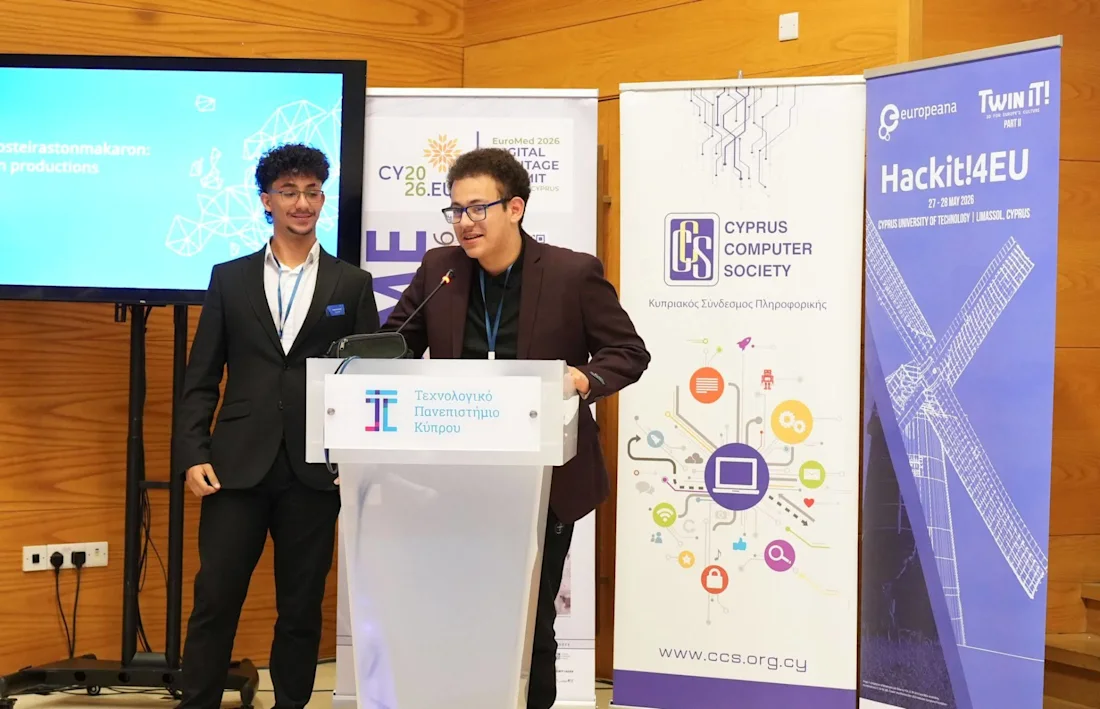
The team consisted of Andreas Dimitriou, Christos Pitsillidis, Zacharias Prodromi, Stylianos Stylianou and Efstathios Zaharias Zahri.
Passionate about technology, innovation and cultural heritage, these five students combined their skills in software development, design and problem-solving to create Cyprus Planner. Their project uses AI and interactive digital experiences to make cultural heritage more engaging and accessible, aiming to connect history with modern technology in a way that is educational, immersive and entertaining.
‘Working together was both enjoyable and rewarding, as each team member contributed unique ideas and skills. Our inspiration came from finding new ways to make cultural heritage more interactive and engaging, especially for younger audiences.’ - Christos Pitsillides
See the results for yourself in this demonstration video of their application.
Other Projects
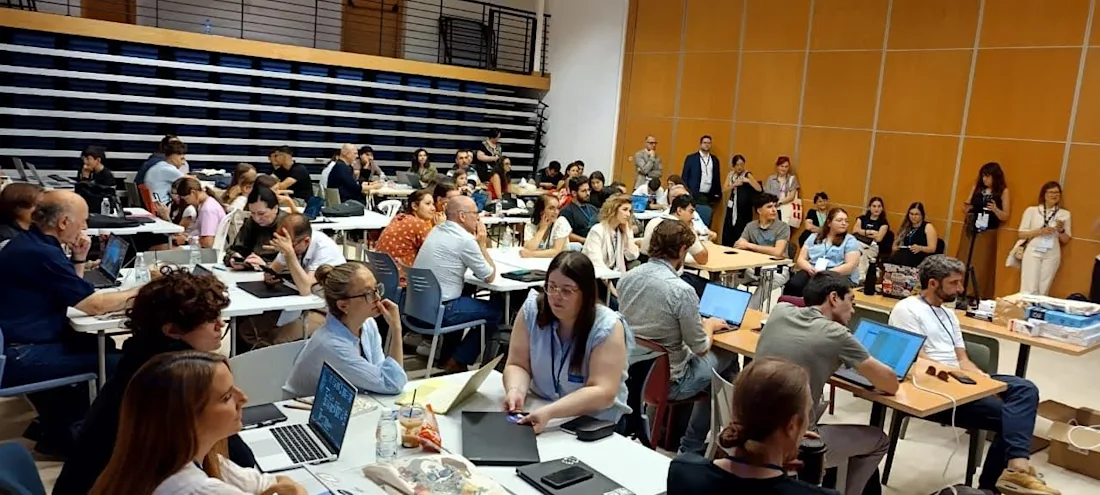
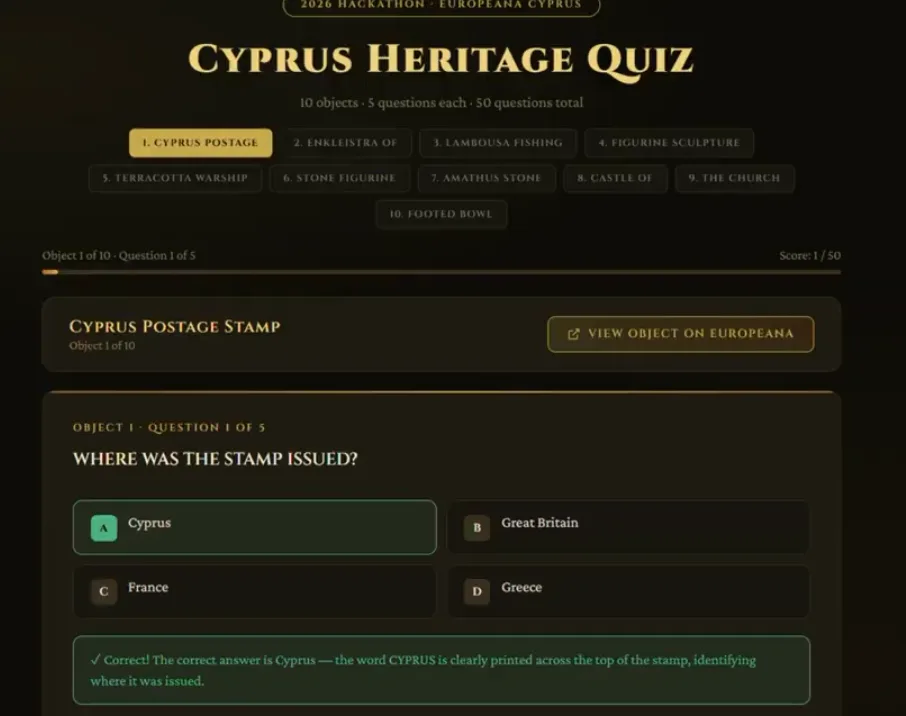
1. Cyprus Heritage Quiz Challenge
Created by five second-year students from a high school in Larnaca together with their history teacher, the quiz aimed to combine programming with cultural heritage education. Together, they developed a practical educational tool that enhances history teaching through primary sources, promoting authentic engagement. By transforming cultural heritage into a ‘living museum’, the team integrated diverse historical periods, media, 3D models and gamification. This approach created an interactive, immersive learning experience, helping students connect with history more deeply and meaningfully.
2. Aphrodite’s Travel
Aphrodite’s Travel is an interactive tourism experience transforming Cyprus into a living adventure. The app that the team developed combined mythology, archaeology, maritime heritage and gamified exploration through an interactive map connecting iconic locations represented by different media, such as Aphrodite’s Rock, Paphos Castle and the archaeological site of Khirotikia.
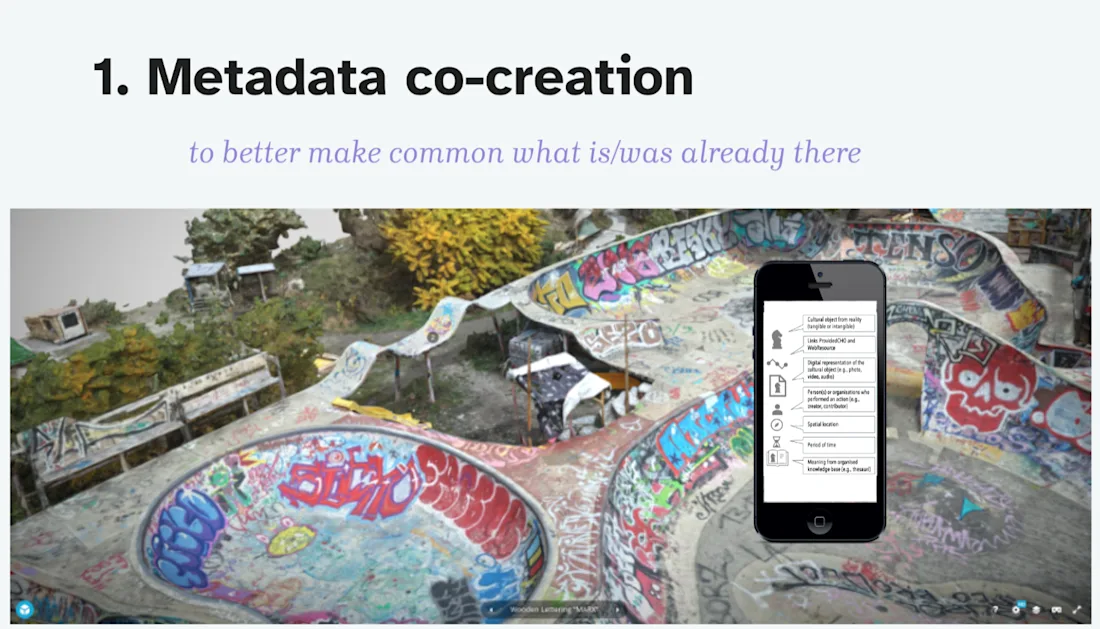
3. Street Stories
Inspired by the 3D model of the now-demolished Skatepark Sankt Marx in Austria, the team sought to highlight the diversity and depth of urban geography by creating a collaborative augmented reality platform where users can experience, relive and contribute to street art, graffiti and urban exploration. It showcases that even when graffiti is erased or painted over, its memory and testimony as an expression of diversity, contestation and local identities remains.
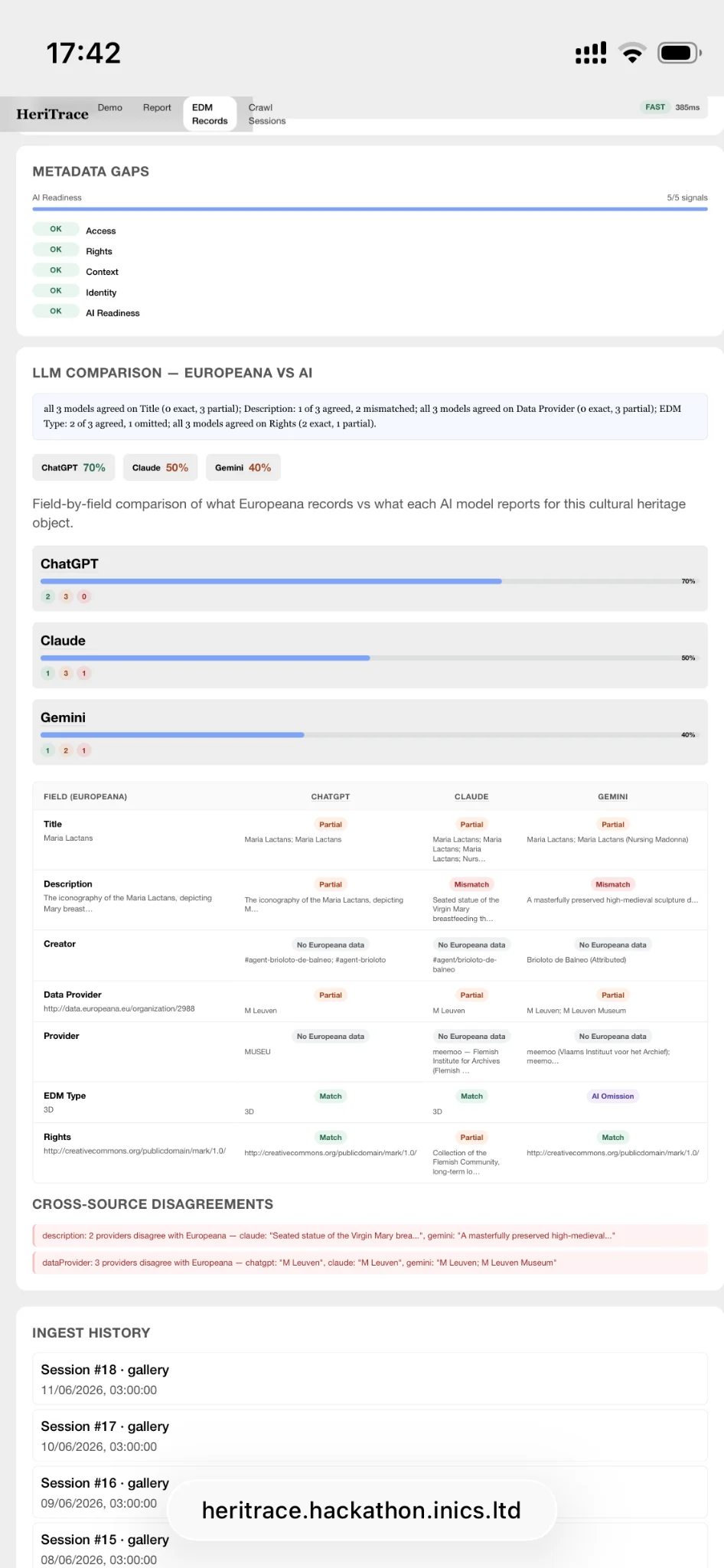
4. Puit.is
The team created an AI-powered digital curation platform that evaluates both 2D and 3D cultural heritage data. For example, using the 3D model of the castle of Paphos, the platform evaluates whether AI-generated responses about the model are factual and complete, respect copyright and are contextually relevant. With this platform, all 60+ million Europeana assets can be evaluated, reported and accessed automatically, while simultaneously creating a marketplace for curated assets.
5. HERstories of Antiquity
A 3D storytelling application, HERstories of Antiquity highlights the experiences of various women across the centuries by taking historical artifacts depicting women in the form of statues, sarcophagi and paintings, and bringing them to life. The women retell their stories while the user explores virtual museums, historical sites and maps, reflecting history through the female gaze.
6. Grand Tour
‘From Delos to the Deep' is an immersive digital storytelling project that reconstructs the journey of an 18th‑century aristocratic woman on the Grand Tour. Combining 3D heritage assets, fashion history and archival sources, it traces her visit to Delos and the tragic shipwreck that followed. Through a first-person narrative and interactive media, the project explores identity, travel and loss. While the story is fictional, it is created from authentic Europeana collection materials, demonstrating how digital storytelling can revive heritage assets and inspire new interpretations of the past.
7. Heritage Malta
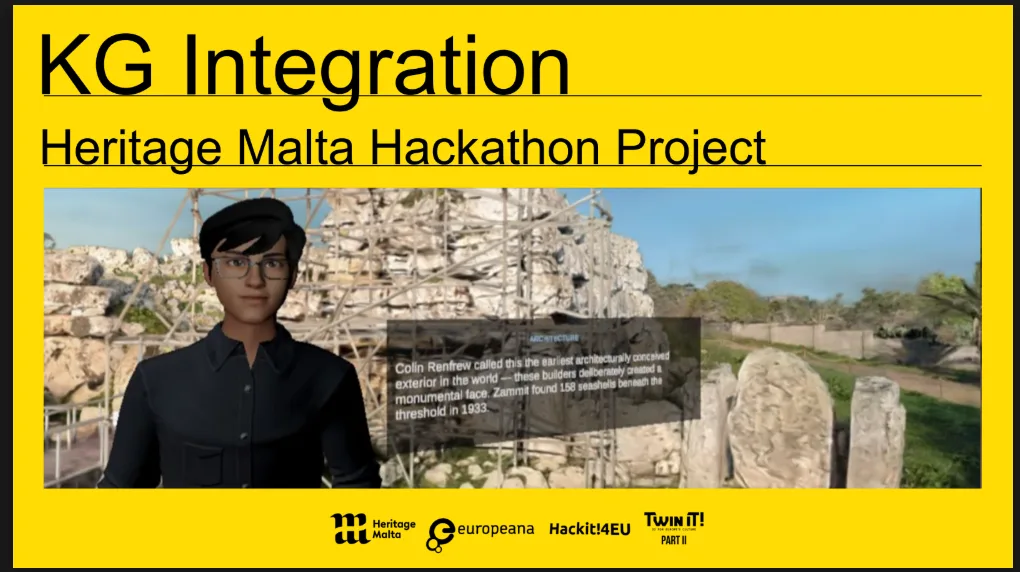
The Heritage Malta team created a virtual reality application that enables the user to explore the Ġgantija Temples in Malta in real time, with the help of a virtual guide. The project was developed on Unity and integrates KG and RFIDs to immerse the user into a virtual world of precision where they can interact with various objects, characters and histories. It imagines a museum where visitors can select a physical model and be transported into an immersive world that is creative, accessible and educational.
Hackathons are a great way to explore cultural heritage content, meet new people from across disciplines, and to train creative thinking.
‘Attending the Hackit!4EU hackathon fundamentally changed my perspective on digital cultural heritage.Tackling preservation and sustainable tourism challenges alongside pan-European peers sharply refined both my technical and cross-cultural skills. Ultimately, this intense, innovation-driven experience has definitively shaped the trajectory and next steps of my professional journey.’ - Giannina Sontea
Besides giving the participants the space and opportunity to reuse 3D cultural heritage, Hackit!4EU served as a great opportunity to meet like-minded individuals, to innovate and to learn more about the 3D cultural heritage space and tools. From first-time hackathon participants to seasoned professionals, the event showcased what can happen when cross-sector collaboration is channeled into a single challenge.
Would you like to invite the Europeana Foundation team to your hackathon or collaborate together on a creative reuse event? Email us at [email protected].