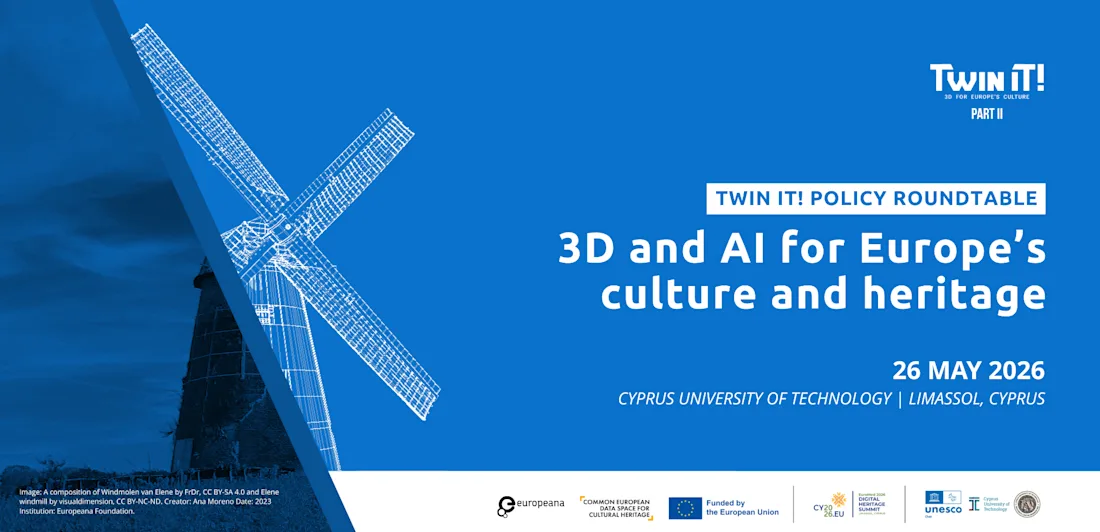
Organised by the Europeana Foundation in partnership with the European Commission and CUT under the auspices of the Cypriot Presidency of the Council of the EU, the Twin it! Policy Roundtable: 3D and AI for Europe’s culture and heritage brought together policymakers, technology specialists, and cultural heritage experts and professionals from Cyprus and Europe. The Roundtable took place on 26 May 2026, as part of the Twin it! Part II Grand Final, a series of three complementary events to celebrate the success and conclusion of the campaign.
The core challenge and the vision: escalating to a massive new scale
Building on the Twin it! Call to Action and set within the context of the Twin it! Part II 3D campaign and the broader Digital Heritage Summit 2026, the Roundtable unpacked the hurdle of meeting the EU's ambitious 2030 digital goals and targets for cultural heritage as outlined in the European Commission's 2021 Recommendation on a common European data space for cultural heritage.
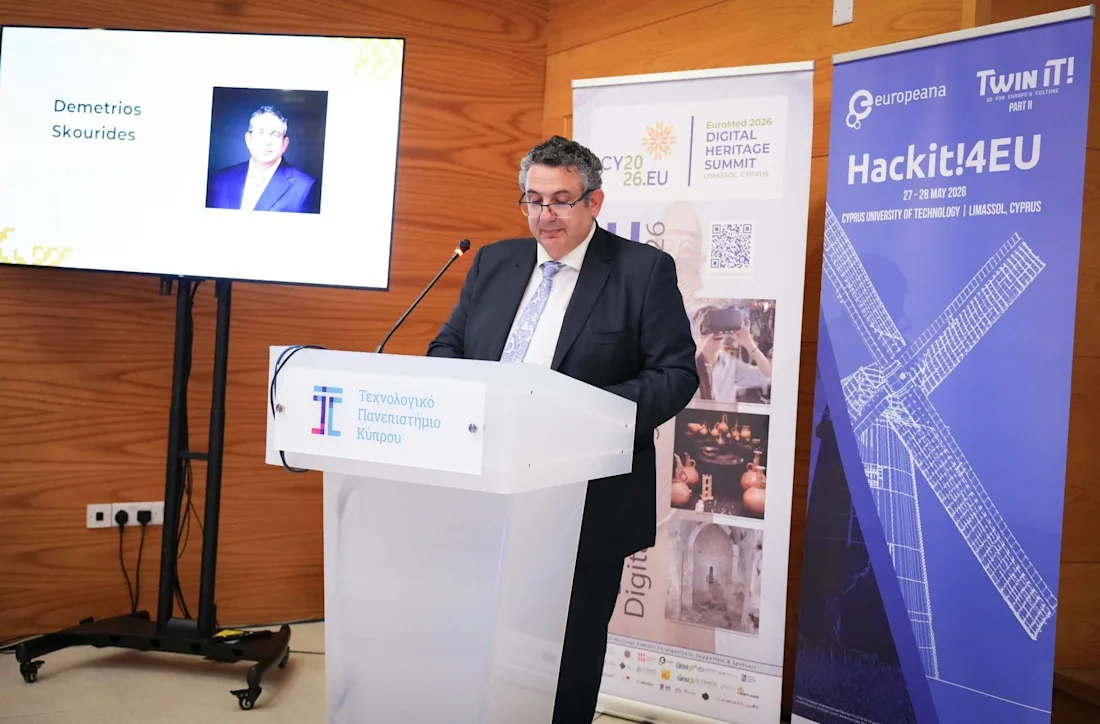
Opening speakers Rehana Schwinninger-Ladak (Head of Unit for Data Applications and Creativity at DG CONNECT, European Commission), and Demetrios Skourides (Chief Scientist for Research, Innovation and Technology, Republic of Cyprus), emphasised that Twin it! is a coordinated effort to build a European memory infrastructure, and Harry Verwayen (General Director of Europeana Foundation) highlighted the need for scaling and accelerating 3D digitisation, access and reuse. The catalyst for this transformation? Artificial Intelligence.
Together, they outlined a vision which:
- Demands a holistic ecosystem. We must align cultural heritage with the broader EU digital strategy, creating powerful synergies between EU data spaces and AI Factories. Europe’s rich cultural heritage supports the Apply AI Strategy and the European Data Union Strategy, providing strategic fuel for the national and broader European economy and competitiveness.
- Guards values. This evolution must be ethical, public-interest driven, and compliant with the EU AI Act, where human values and data sovereignty come first.
- Empowers people. We cannot leave our institutions behind. A massive commitment to upskilling will ensure professionals are ready to lead this advanced technology revolution in the cultural heritage sector.
Inspiration
Marco Medici (CEO of INCEPTION, and Coordinator of the 3D-4CH Competence Centre) inspired the audience with a presentation of the Trajan's Column 3D-AI project – a practical convergence of these technologies.
Key pillars for a collaborative roadmap
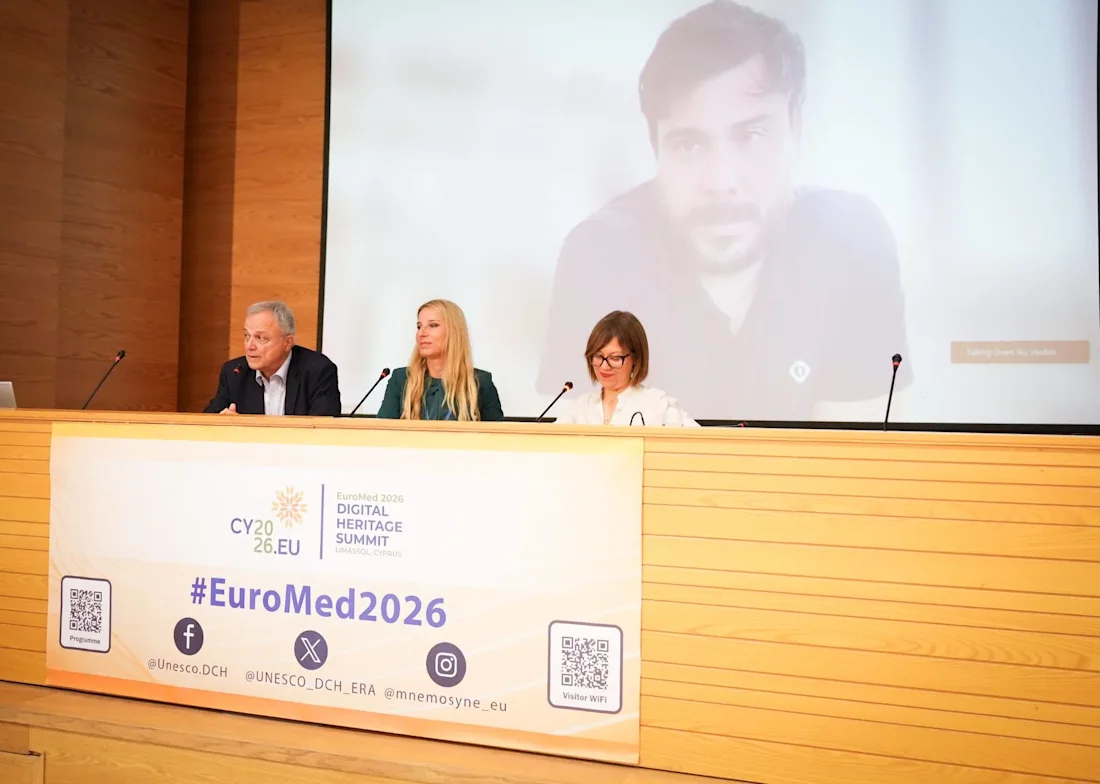
Moderated by Sofie Taes (Chair of the Europeana Network Association), and an esteemed panel of experts spanning national, international and technical domains: Stefanos Kollias (Chairman of GRNET and Coordinator of PHAROS), Ines Vodopivec (Secretary General of AI4LAM), and Marco Medici debated what it will take to successfully move this vision forward:
- Powerful synergies. There lies a massive potential in the emerging European AI Factories such as the Greek AI Factory, PHAROS and Data Labs. By joining forces and ensuring technical interoperability, the common European data space for cultural heritage and these AI hubs can provide the computing power and infrastructure or tools needed for mass scale automation of 3D digitisation, access and reuse.
- Capacity building and upskilling. Technology without skilled people is hollow. The sector faces an urgent need to upskill cultural heritage professionals, pointing to grassroots community efforts as critical drivers. Cultural heritage professionals must be active architects of the future, and positive ambassadors of digital transformation.
- Ethical and public-interest AI. The digital transformation must remain human-centric, transparent and respectful of data sovereignty, ensuring that priceless cultural data is never absorbed by opaque or extractive AI systems.
A collective call to action
The Roundtable concluded with a pathway for the future, calling for:
- Joint advocacy. Rallying towards EU institutions for dedicated resource allocation in the next Multiannual Financial Framework to support an EU-funded mechanism for AI-driven 3D digitisation, access and reuse.
- Strategic alliances. Deepening structural links between the common European data space for cultural heritage, national AI Factories, the 3D-4CH Competence Centre, and innovation networks and initiatives like AI4LAM, ECHOES/Collaborative Cloud, and Time Machine.
- A shared Member State hub. Transforming the data space for cultural heritage into a central ecosystem where EU Member States can collaborate, pool resources, share technical expertise, and experiment in this area.
Europeana Foundation will build on this vital discussion in the future with Member States and partners.
Experience the Roundtable
If you missed the live stream, you can catch up on the full 90-minute Roundtable, beginning at 4:46:51 in the video.