QueryLab started in 2018 and has since grown into a platform dedicated to tangible and intangible heritage. Its starting point was a small inventory of intangible heritage relating to Italian traditions, with the question: how is intangible heritage dealt with outside Italy?
Inspiration came from Europeana.eu, which makes large amounts of data from different sources available in a single portal and allows access to the data through API services. The Europeana APIs were used in combination with custom code. Europeana.eu encouraged us to look for other online cultural heritage platforms with a focus on intangible heritage, which also provide API services for search.
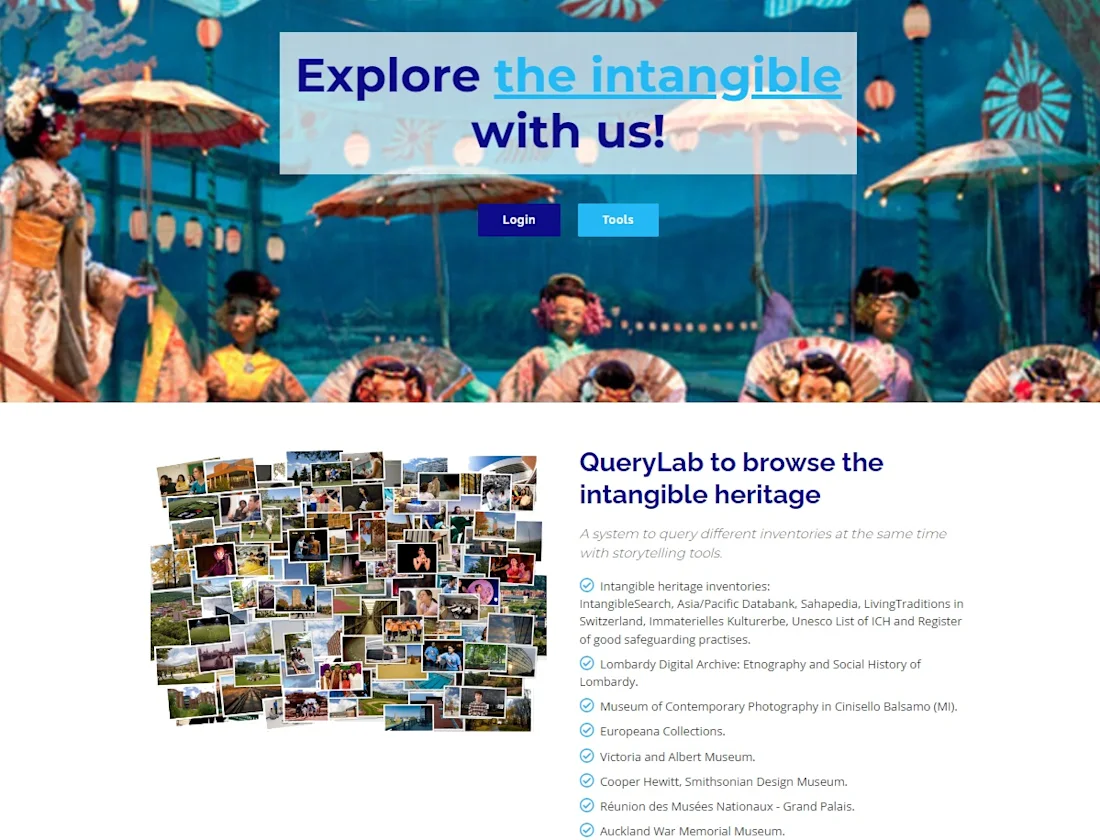
From a research point of view, the QueryLab portal has become a test bed for experimenting with querying and accessing data, thanks to the huge amount of data that it gives access to. Our focus has been on usability, managing different content languages, user experience and creating thematic routes by extracting and classifying the most common tags.
How does QueryLab work?
The system searches in a language-agnostic way using Linked Open Data, so people can search in the language they prefer, or navigate between the guided tours created, bypassing the problem of coming up with something to write in a search empty box.
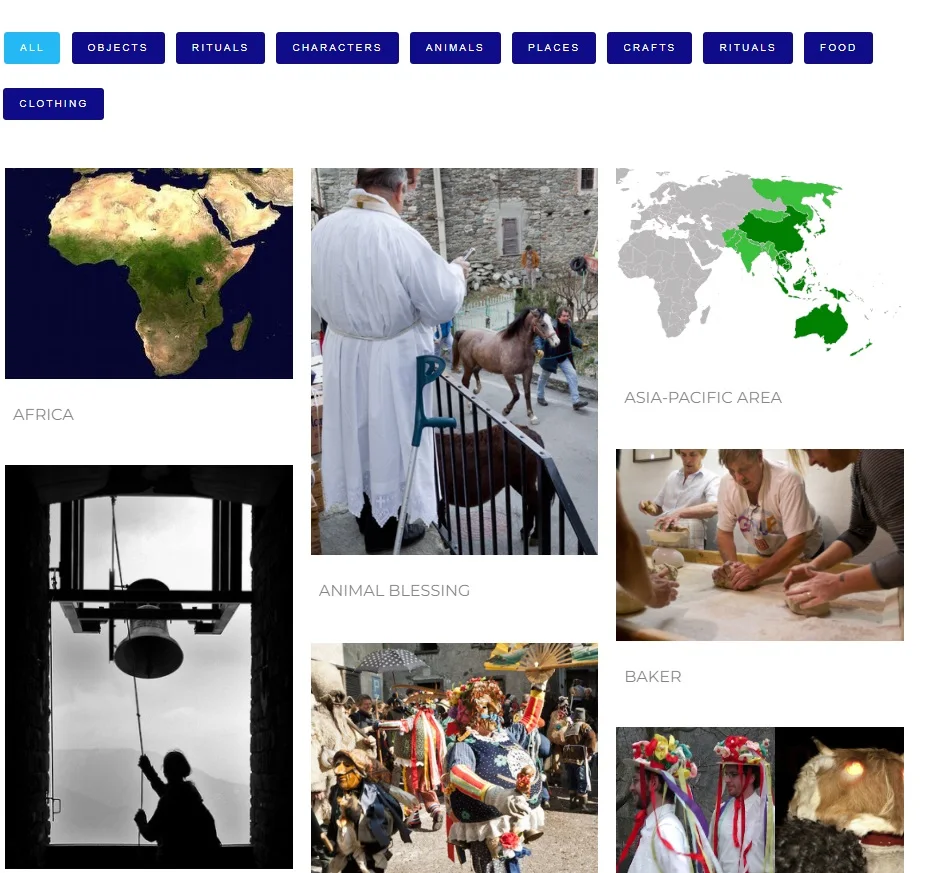
Through QueryLab, you can compare cultures, customs and traditions, making connections that were not possible before due to search constraints and siloed data platforms. To facilitate searching to people with different backgrounds and capabilities, several interaction methods are available, such as themed routes created through a process that analyses and organises the tags associated with the objects, and serious games based on content extracted from QueryLab results.
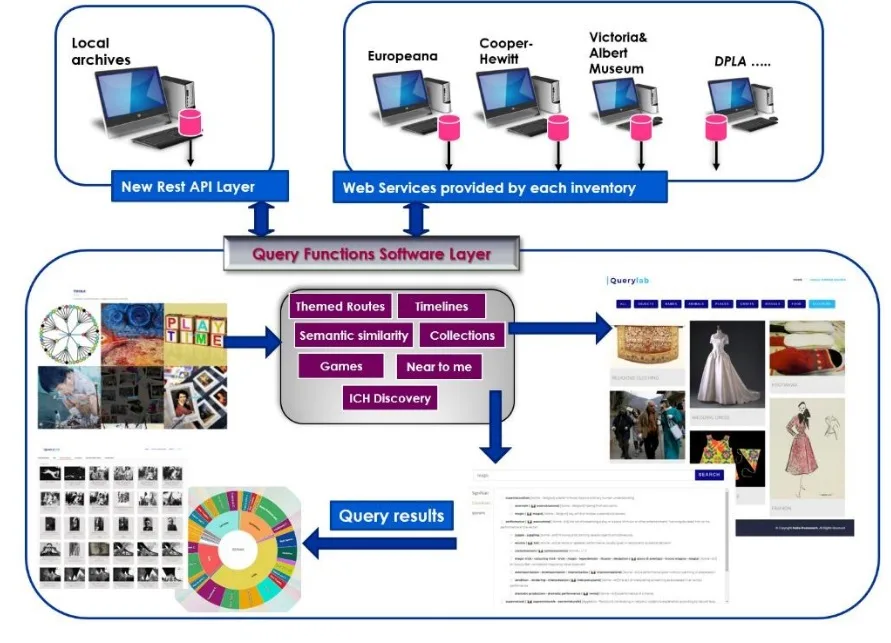
QueryLab functions as a sort of dashboard. It takes the query submitted by a user, sends requests to different web APIs at the same time, and translates all the responses from these different APIs into one graphical format. In this way, the user can search up to eleven online databases at once, three of them accessible locally, and get all the results at the same time.
The use of the Europeana APIs
We started by connecting the Europeana APIs with other Italian inventories available locally, dedicated to ethnography, social history, and contemporary photography.
The user-friendly approach of the console, the clear documentation of the parameters available for querying and interpreting search results, and the faceting services for filtering and refining data are what we liked best about the Europeana APIs. These characteristics guided us when searching for other similar web services and trying to broaden the range of sources available in Querylab.
We did not always find the same level of documentation, degree of parameter refinement and ease of use in all web services, which offer different levels of detail and complexity, sometimes making integration onerous. The Europeana APIs have been a benchmark in our experience and should be considered as a best practice for the development of this type of service by data providers.
A bottom-up approach
The core concept of the platform is expressed by its motto ‘Explore the intangible with us!’. In practice, however, the content of API-integrated inventories is mostly related to tangible heritage, simply because cultural heritage collections are mainly composed of physical objects by their nature. Even in cases where intangible heritage is among the assets catalogued, it is still managed as documents, rather than ‘living assets’, memories of people and communities that evolve over time.
We studied how 'truly intangible' assets (for example, knowledge of local weaving patterns) could be added to the inventories, giving these assets a specific identity and a section of its own. To this end, we created the 'IntangibleHeritage' inventory, based on a model called ICH-Light, which is the one that indexes data collected from different inventories, so ingestion of data that isn't available trough web services is anyway possible from local cultural heritage databases. It has been created through a bottom-up approach, which has involved analysis of different databases and metadata from different countries and cataloguing methods.
Support the next steps of QueryLab
Our goals are to create a new ontology to classify intangible cultural heritage data, and to analyse which ontologies are most appropriate for the description of intangible heritage. The data model that we are developing ourselves has already been evaluated against other models like EDM (the Europeana Data Model) and CHDE (Cultural Heritage in Digital Environment). This evaluation aimed to explore which classes and properties can be mapped and whether an extension of data models is needed.
We hope that the creation of QueryLab will contribute to better knowledge and dissemination of tangible and intangible cultural heritage, both by facilitating the connection between the different sources scattered on the web, and by highlighting the common aspects of the cultures of different peoples.
Would you like to support this aim? Do you own a data model that you want to integrate into the ICH-Light model, or do you have expert knowledge in vocabulary mapping, and an interest in intangible cultural heritage? If you would like to participate in the development of the ontology, please contact [email protected].
Don’t forget to explore QueryLab and the recently updated documentation for the Europeana APIs!