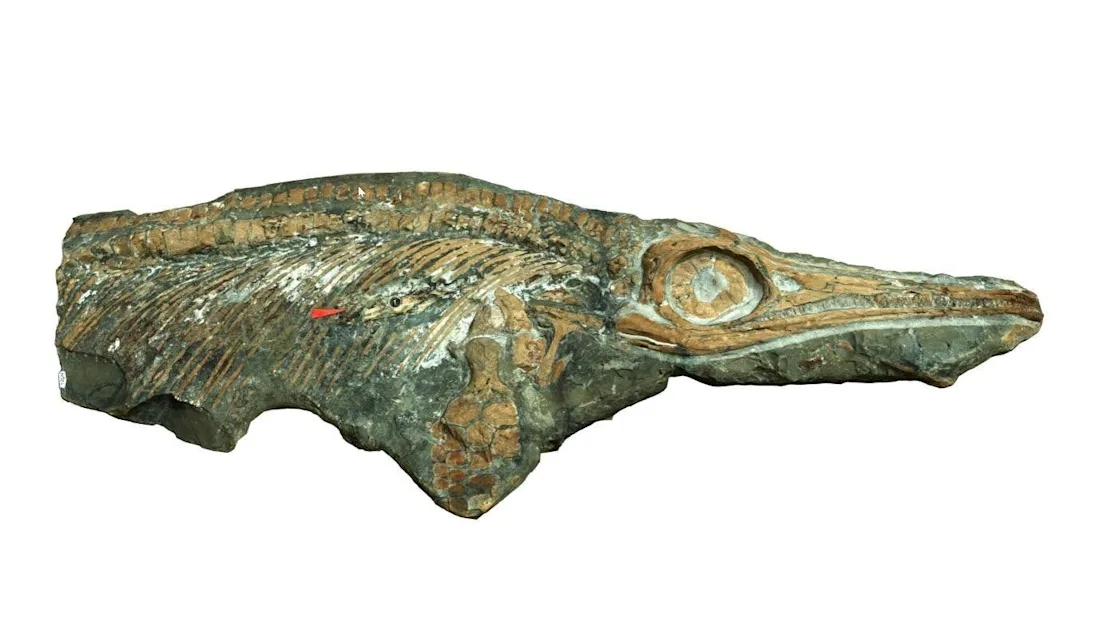
Luxembourg’s Bascharage Lagerstätte is a treasure trove of Early Jurassic marine life, with fossils including a specimen Stenopterygius quadriscissus – an ichthyosaur containing the first known evidence of octobrachian predation – preserved in a 180-million-year-old schist layer. While these specimens have long been studied and exhibited at the Musée national d'histoire naturelle Luxembourg (MNHNL), the time has come to propel them into the digital age.
A few years ago, the MNHNL embraced 3D digitisation, using photogrammetry to create high-resolution models of a fraction of its tens of thousands of fossils. These digital surrogates not only support research and conservation but also make fragile specimens accessible to global audiences, beyond the museum’s physical exhibition or storage walls.
Yet, digitisation alone is not enough. Digital models must be dynamic tools – used for education, research and public engagement. This is where Twin it! comes in. The campaign, led by the Europeana Initiative and the European Commission, invites EU Member States to contribute high-quality 3D models of their cultural heritage to a common European data space, with a focus on reuse in education and beyond. For Luxembourg’s contribution to Twin it! Part II, the Stenopterygius quadriscissus fossil (TV211) was an obvious choice due to its scientific significance demonstrated in a research paper by the museum's researchers.
The 3D Digitisation Process
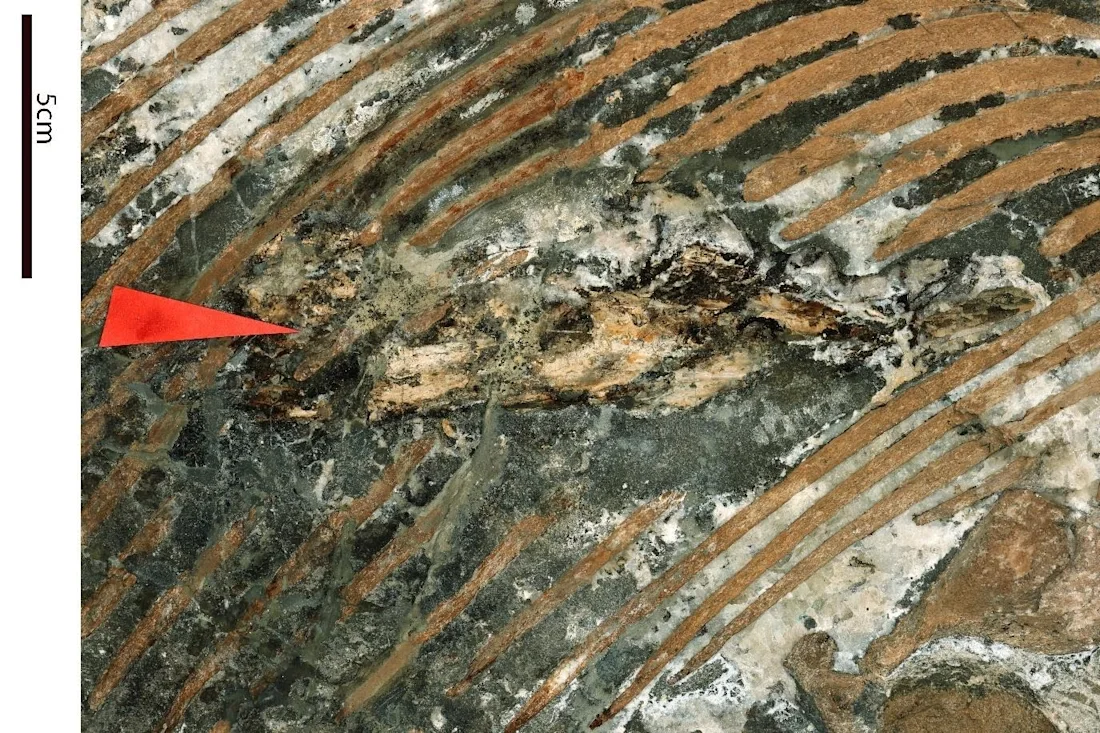
The image above is a detailed view of the fossil remains of a vampyromorph coleoid within the stomach of an ichthyosaur fossil from Luxembourg.
The Ichthyosaurus fossil was digitised using photogrammetry: 313 high-resolution images were captured with cross-polarised ring flash lighting to reveal its surface in exceptional detail. The images were processed in 3DF Zephyr, resulting in a textured 3D mesh that preserves the fossil’s intricate morphology – from its vertebrae to the remains of its prey. The photogrammetry technique was chosen by the museum due to existing imaging equipment and because it allows enough flexibility to capture the smallest fossils of only a few centimetres to those spanning several metres.
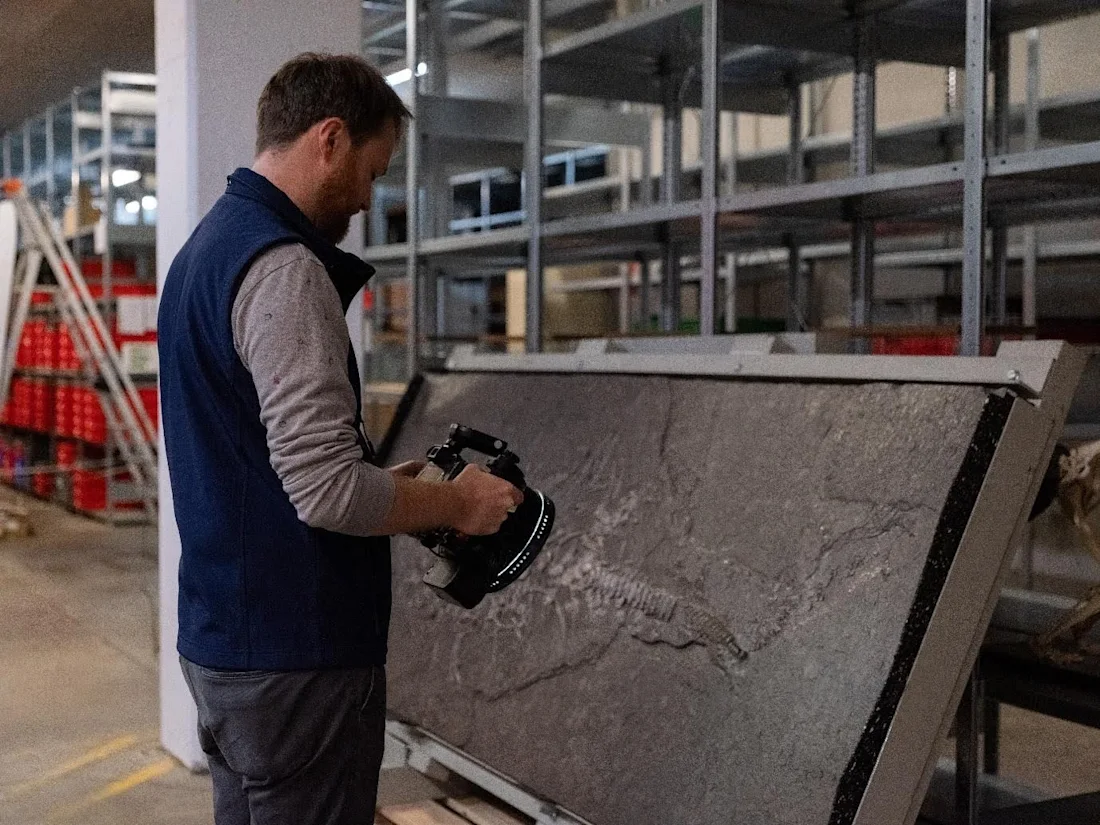
The image above features the photographic documentation process of an ichthyosaur specimen from the MNHNL palaeontological collection using polarised light.
While 3D scanning captures stunning surface details, it also generates large datasets. To balance accessibility and quality, reduced versions of the models are available on platforms like Sketchfab for casual inspection. Meanwhile, high-resolution models and the original images are freely accessible under a CC BY 4.0 licence via Luxembourg’s open data platform, data.public.lu, where you can find the dataset for the 3D reconstruction of MNHNL's Ichthyosaurus fossil. This ensures researchers, educators and creators can reuse, adapt and share the data as needed.
Visions for 3D in the future
With this exceptional model now part of the common European data space for cultural heritage, the MNHNL is prioritising the preservation of its most fragile specimens. For some fossils, 3D scanning is the only way to safeguard their current state for future generations, as some are susceptible to degradation due to the oxidation of iron-rich minerals in their schist matrix.
Beyond conservation, the MNHNL is expanding access to its digitised collections. In collaboration with the Europeana aggregator OpenUP!, the museum plans to publish thousands of digitised specimens – including 300 with 3D scans – via Europeana.eu using the Global Biodiversity Information Facility (GBIF) data pipeline later this year. This initiative is an effort to not only make the museum’s data available beyond its typical scientific audience, but also to encourage the reuse of its assets by the broader educational and creative sectors.
Explore the 3D fossil yourself
View MNHNL’s Stenopterygius quadriscissus 3D reconstruction model in detail on Europeana.eu, and find out more about Twin it! Part II on the data space website news section.