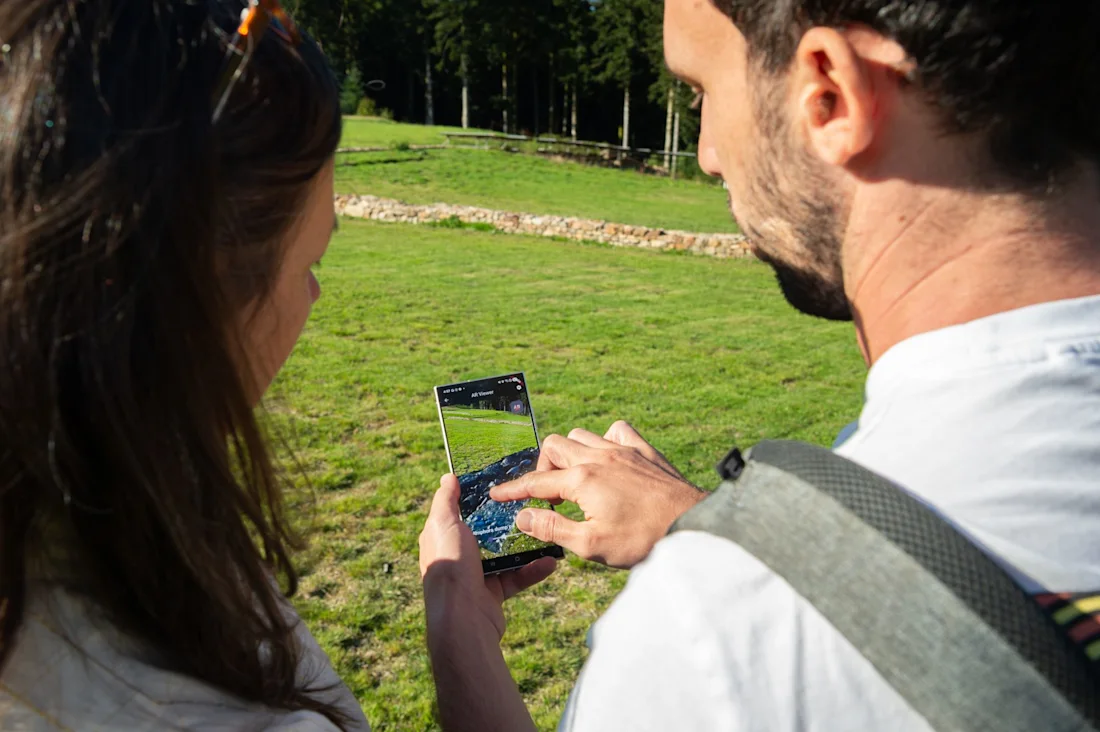
EUreka3D-XR is the continuation project of EUreka3D, co-funded by the Digital Europe Programme of the European Union. The project is developing innovative reuse scenarios and tools to create extended reality (XR) applications, expanding the features and services developed and tested in the previous project.
Building upon the past and creating the future of cultural heritage
The EUreka3D initiative contributes to Europeana and to the common European data space for cultural heritage through two projects: the first one, named EUreka3D (2023-2024), successfully established a platform of guidelines, recommendations and digital infrastructure services. The second project, EUreka3D-XR, aims to experiment with the reuse of 3D cultural content through extended reality (XR) experiences by using three very different scenarios.
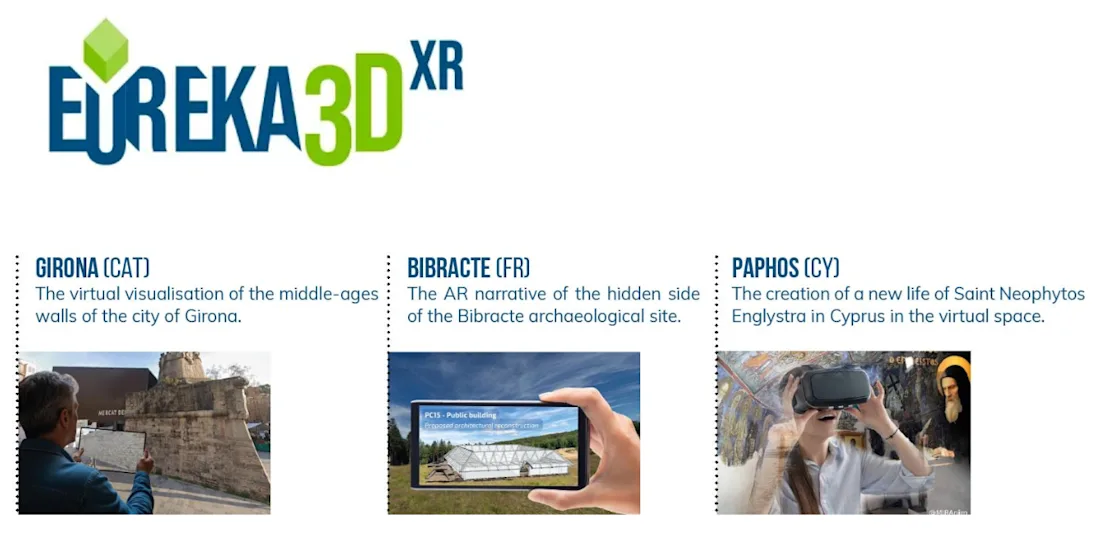
The first scenario uses the findings and collections of the Girona Municipal Archive to reconstruct the sector of the city’s historical walls that were demolished at the beginning of the 20th century, employing AI technologies. The second scenario maps points of interest for the archaeological site of Bibracte, offering an enriched AR experience for visitors, placing 3D representations of museum artefacts and virtual reconstructions of lost buildings back into the landscape context. The third scenario combines the 3D digitisation of the Enkleistra of St. Neophytos in Paphos and its Byzantine frescoes together with historical documents, to deliver a range of virtual reality (VR) experiences that enable visitors to interact with a virtual avatar of the saint and listen to the story of his life in the Enkleistra.
Learn more about the pilots of EUreka3D.
3D and XR for cultural heritage: data quality, authenticity and memory preservation
The pursuit of 3D digitisation and immersive representations of reality constitutes an avant-garde development of the everlasting tendency of the human race to record and preserve not only the world that surrounds us, but also the history and the sociocultural values that it holds. Therefore, rather than constituting a radical break with earlier forms of documentation, 3D and extended reality technologies represent another step in humanity’s enduring ambition to capture reality.
To preserve the value of cultural heritage and appropriately maintain it through 3D digitisation, EUreka3D-XR heavily relies on the concept of ‘memory twins’ – a holistic framework for integrating both tangible and intangible dimensions of heritage. The concept of ‘memory twins’ aims to ensure that cultural heritage preservation goes beyond the ’digital twin’ – a sterile reproduction of the artefact – and instead promotes a living, accessible, and shared form of heritage capable of preserving humanity’s collective memory through the technologies of the present and the future.
Metadata and paradata embodied in the duality of memory and digital twins perfectly perfectly aim to fill two different gaps. One – metadata – is purely informative, providing essential information about the identity, provenance, ownership, format and relationships of digital assets. The other – paradata – encompasses a wide range of information, from high-level interpretive reasoning to detailed documentation of how digital representations were produced. The EUreka3D-XR project puts specific focus on the latter, since recording information regarding the process of 3D digitisation of an object also helps keep track of necessary reconstruction, interpolation or modelling steps, amplifying interpretative choices that go beyond direct observation.
The EUreka3D-XR project approaches tool development as part of a broader methodological framework. The project aims to integrate metadata and paradata’s capture, management and dissemination into digitisation and publication workflows from the outset. By doing so, the project supports cultural heritage institutions and practitioners in producing immersive 3D experiences that are not only visually engaging but also transparent, interpretable and trustworthy over time.
Providing digital infrastructures and accessible support
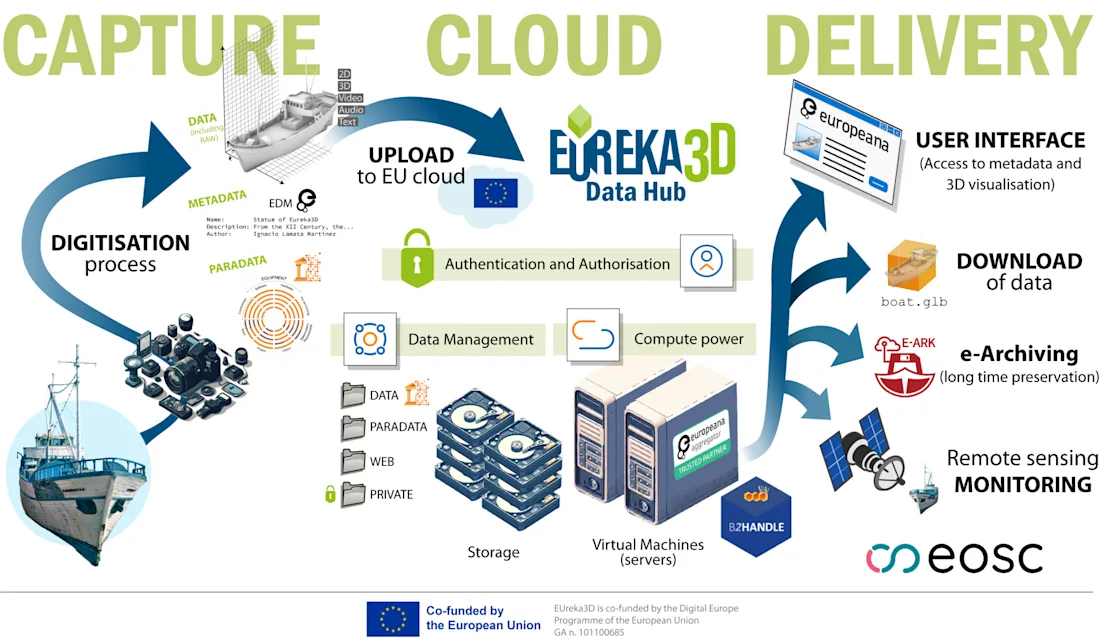
To carry out a project this ambitious, EUreka3D and EUreka3D-XR had to develop and improve a centralised cloud infrastructure. With EUreka3D, the EUreka3D Data Hub was created to securely host 3D models from any cultural heritage institution, allowing for clear metadata and paradata modelling and linking, providing persistent identifiers and Linked Open Data, mapping to the Europeana Data Model, and making these models accessible and viewable both on the EUreka3D Viewer and on Europeana – once the objects have been aggregated. Eureka3D-XR built upon this existing framework, that offers a service that is free of charge and completely based in Europe, and provided improvements consisting of a playground of the platform, a new list of materials, support for the extension of EDM for 3D, and a catalogue.
To further support CHIs in the reuse of their 3D digitised content to produce more modern and compelling storytelling, enhancing the visitor experience and engagement with cultural collections, EUreka3D-XR developed five open-source tools: the AR Tour Builder, the AR Tour Experience, the AI 3D Builder, the 3D XR Studio, and the Avatar Builder. These tools allow curators to create and experiment with different types of XR applications to foster the reuse of 3D digitised assets. Each tool is openly accessible and accompanied by easy-to-understand documentation, manuals and video tutorials, and was first tested on the case scenarios within the project.
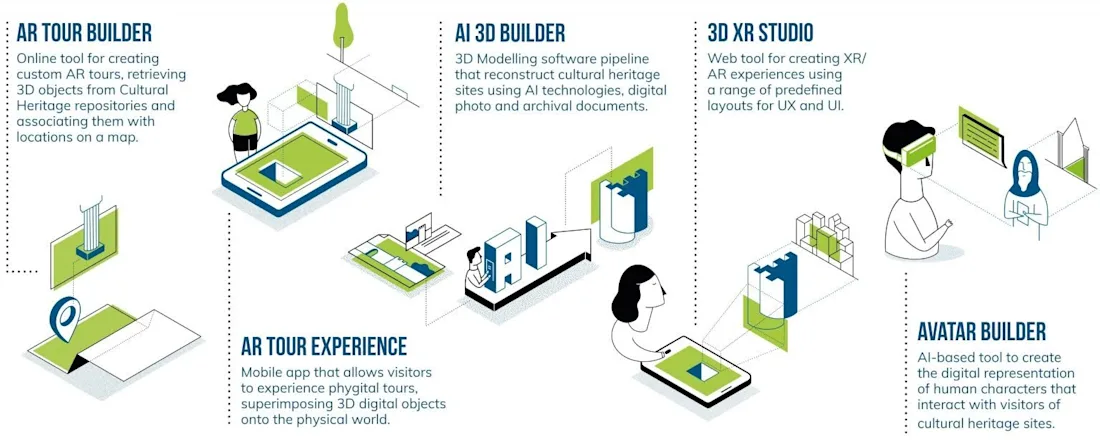
Discover the 5 open source tools developed by the project
Beyond the project: EUreka3D-XR supporting the Twin It! campaign
The efforts of EUreka3D-XR stretch even beyond the boundaries of the project itself. Under Twin it! (June 2023 to June 2024), the Ministries of Culture of the European Union’s Member States were invited to liaise with their national cultural institutions to submit at least one 3D digitised heritage asset to the common European data space for cultural heritage. EUreka3D-XR offered its support to encourage the initiative, and enabled the publication of 3D models from various Member States such as Greece, Portugal, Spain, Cyprus, Estonia, Germany, Belgium and the UK through the EUreka3D Data Hub.
Learn more
The project produced an open-access booklet which summarises the project’s journey to support cultural heritage institutions in the digital transformation and innovation processes in 3D and XR, with a focus on the new common European data space for cultural heritage.
Download the EUreka3D-XR: 3D and XR in European Digital Cultural Heritage booklet.