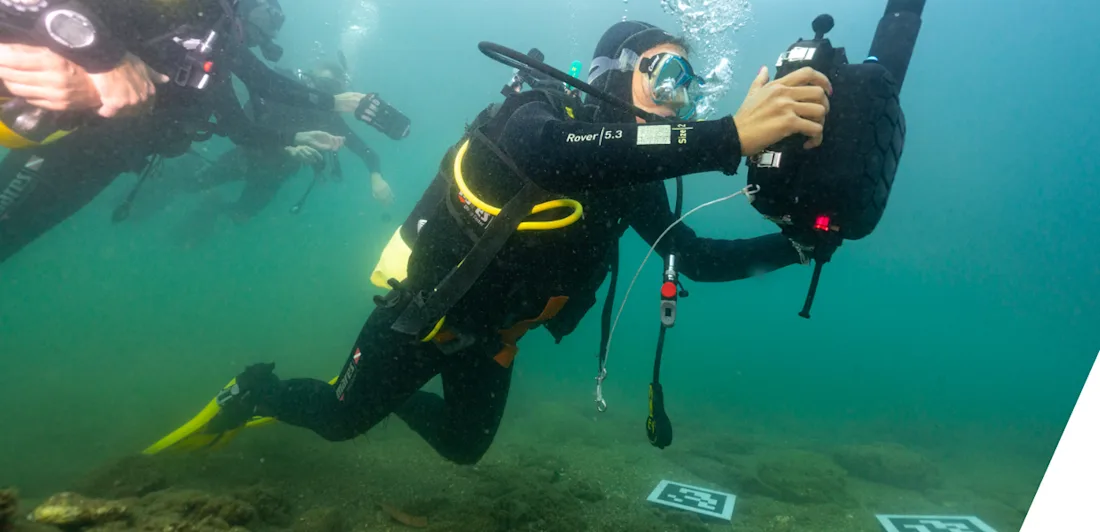
In autumn 2021, Europeana was proud to be part of the international jury for the annual and prestigious Heritage in Motion awards, run by Europa Nostra and the European Museum Academy. In this theme, we talk to the 2021 award winners and find out how the cultural heritage sector is using new digital technologies in their inspiring projects.
Today, Fabio Bruno and Marco Cozza tell us about Underwater Augmented Reality (UWAR), which received a ‘Special Mention’ in 2021.
Tell us a little bit about your winning project
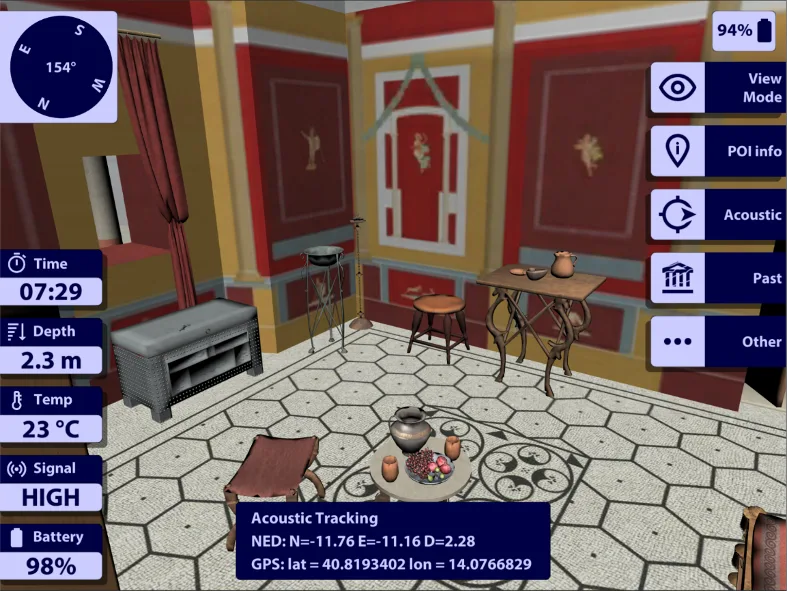
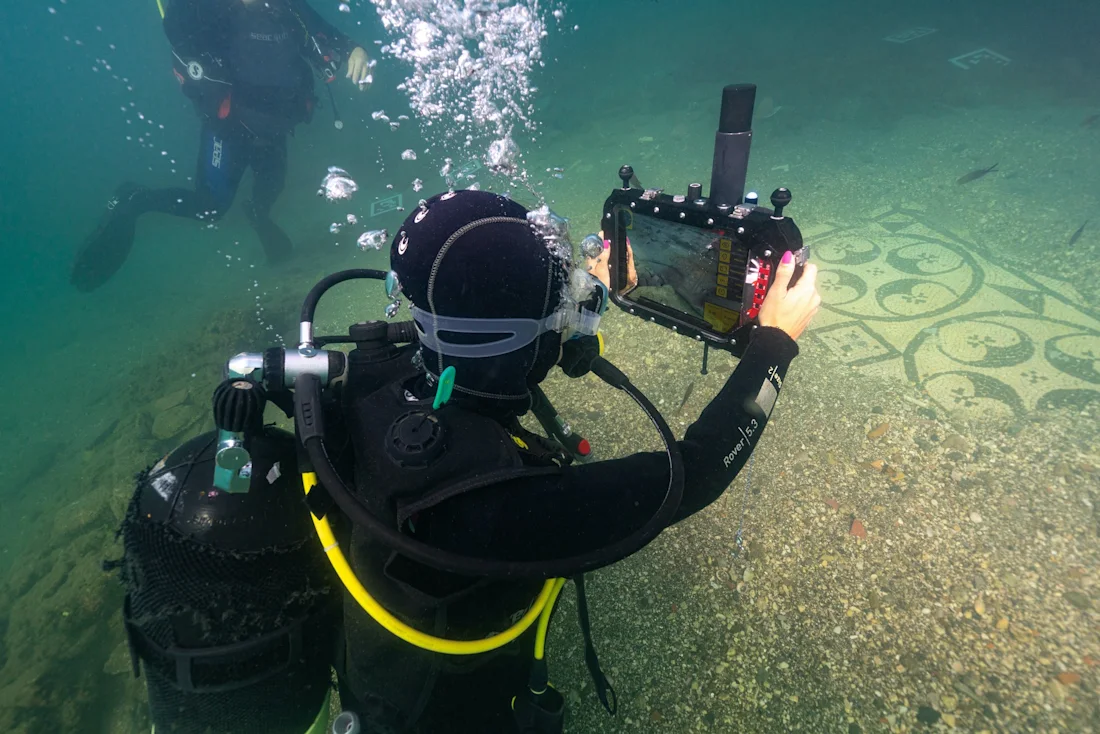
Divy is a system for divers that supports navigation and exploration through an underwater tablet coupled with an underwater navigation system. It includes a visualisation of a map of the underwater site that shows their position within the submerged site, the possibility to acquire geo-localised data, the visualisation of additional information about specific points of interest, and communication with the surface operators through an underwater messaging system.
The most engaging feature of Divy is its Underwater Augmented Reality (UWAR), which delivers divers a new and more immersive experience than a classic recreational dive. The AR allows the diver to view hypothetical reconstructions of structures and artefacts in an underwater archaeological site, superimposing them and showing how the archaeological remains appeared in the past.
How have your audiences reacted to this project?
The system has been deployed in different underwater cultural heritage sites where several recreational and technical divers had the opportunity to use it. They enjoyed their time and claimed that these kinds of solutions have great potential in underwater archaeology and tourism. In particular, they found the interaction with the AR feature natural and they found the experience very engaging. Experts think that this technology could be very useful for professionals too, supporting surveys and documentation of underwater cultural heritage sites.
What have you learned about working with digital cultural heritage from this project?
Due to water turbidity and biological colonisation, pictures taken in the submerged environment seem to be hazy, in a similar way as when landscape photos are degraded by haze, fog or smoke. It was challenging to develop the UWAR feature dealing with underwater environmental conditions. We had to employ different techniques and implement different solutions to overcome all the challenges faced during the realisation of the Underwater Augmented Reality. In particular, we developed an innovative hybrid tracking solution that merges data coming from the acoustic navigation system and the internal sensors of the tablet to improve the localisation of the diver.
This project gave us the possibility to make further progress in underwater AR technology applied to cultural heritage, by providing a useful tool for tourist divers. What’s more, we had the chance to collaborate with experts to create the virtual hypothetical reconstructions of the sites and to collect their feedback to further improve our solution.
What difference does winning an award like this make to your project/future work?
Achieving a special mention in the Heritage in Motion Award made us realise that our UWAR technology can be attractive not only for experienced divers but also for a wider audience of occasional divers or even for users that have never experienced a dive in an underwater archaeological site. It makes us feel very proud of the effort our team put into the whole project, in studying, analysing, designing, developing and testing this innovative solution to improve divers’ experience.
We believe that new technologies can enhance accessibility and valorisation of underwater cultural heritage, as well as raise awareness about the vast maritime heritage that the Mediterranean Sea holds. So, we will continue work on this topic, with the aim to make underwater cultural heritage accessible to everyone.
We would like to thank all the partners of the iMARECulture project and all those who contributed to achieving this result.