The Petäjävesi Old Church
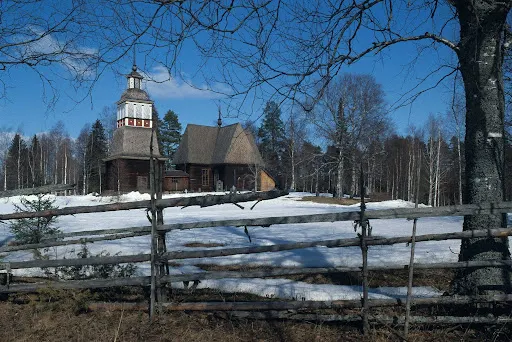
The Petäjävesi Old Church is situated in Petäjävesi, Central Finland, about 230 km north of Helsinki. It was built by land-owning peasants in 1763-1765, when Finland was still part of the Swedish Kingdom. The church, located by the banks of Lake Petäjävesi, was built by master builder Jaakko Klemetinpoika Leppänen. Some 60 years later, his grandson Erkki Jaakonpoika Leppänen supervised the addition of the iconic belltower.
The church is an impressive and representative example of Northern European wooden church architecture; its vaults, central cupola, and lay-out bear influences from European trends from Renaissance to Gothic, but everything is masterfully constructed in the best local log construction tradition. The church is almost entirely built from local pine wood.
The Petäjävesi Old Church has been inscribed on the World Heritage List since 1994, one of Finland’s seven UNESCO sites so far. It can be visited mostly in summertime. Thousands of tourists visit every year.
Visions for 3D in the future
We at the Finnish Heritage Agency foresee clear benefits of 3D digitisation of Finland’s cultural heritage. By using 3D technologies, we can preserve our cultural heritage better than ever before, even though it naturally can never replace the original. The use of 3D-digitisation should be especially ramped up to document more, why not all, Finnish built heritage at risk.
In the case of the Petäjävesi Project, we managed to capture nearly the whole building in 3D with the accuracy and precision of millimetres. Datasets like these are an unparalleled tool for research, protection and monitoring in conservation efforts, and high quality measurements can be accessed digitally even from distance.
Making high quality 3D ‘digital twins’ is time consuming and expensive, so thorough planning and prioritising are paramount. Long-term preservation and findability of 3D data is also crucial, and we need to invest in efficient new infrastructure and expertise in IT and collection management. In the future, we also hope to see more collaboration, participation and knowledge exchange between the cultural heritage and private sectors.
The real winners of 3D digitisation are of course all of us. Through new 3D-technologies, we can create fertile grounds for creativity and business to thrive and make our heritage more easily accessible and available to everyone.