Austria's contribution to the Twin it! campaign
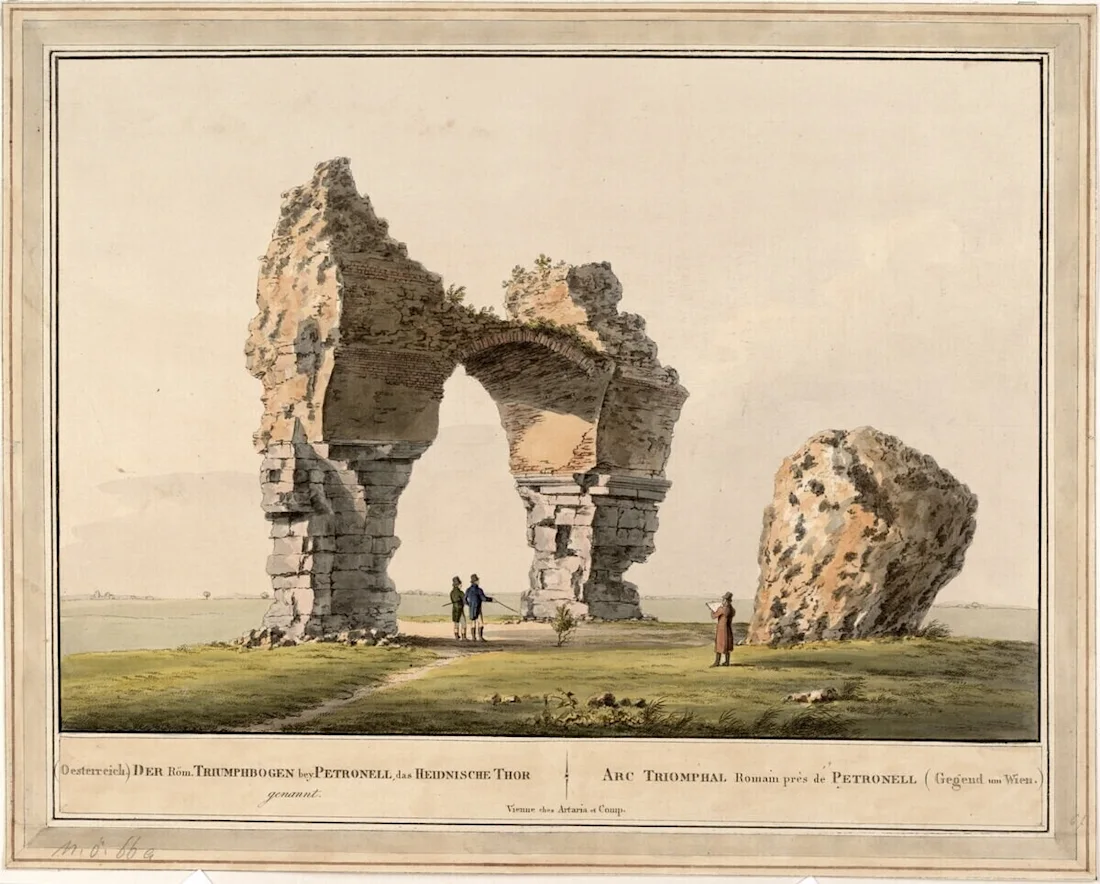
Located near Vienna in the historic site of Carnuntum, the nearly 2,000-year-old Heidentor is a major cultural monument well-known beyond the country's borders; since 2021, the Danube Limes (where the monument is located) has been recognised as Austria's 12th UNESCO World Heritage site, reflecting its significance within the ancient Roman Empire.
The Heidentor was selected for 3D digitisation as part of Austria’s contribution to the Twin it! campaign, a project run by the State Collections of Lower Austria, supported by Kulturpool. The digitisation of the Heidentor makes one detailed digital 3D model of the currently visible structure available. It is complemented by additional 3D models that depict reconstructions of the Heidentor from various historical periods.
The Heidentor from the ancient world to the present
The Heidentor is one of the few Roman monuments in Austria that has been continuously visible for nearly 2,000 years. Many speculations about the builders and the function of the structure abound and have not yet been fully clarified to this day. Its proximity to the ancient city of Carnuntum, an important legionary camp along the Danube Limes and the capital of the Roman province of Upper Pannonia, further enhances its historical significance.
Huge stone robberies in the 15th and 16th centuries significantly shaped the current appearance of the Heidentor. Square stone blocks were particularly desired material and were blasted out using black powder, reducing the two last pillars to the inner core of cast masonry.
The monument’s appearance was then mainly shaped by renovation works in 1907. After further restorations on the surface of the pillars in 1957, the Heidentor was last extensively examined from 1998 to 2001 and preserved according to international standards of monument care. Find out more about the history of the Heidentor.
3D technology preserves Europe's cultural roots
The digitisation of the Heidentor through advanced 3D technology offers insights into the transformative journey of this historical monument, from its inception during the Roman era to its current state. This project, as part of the Twin it! – 3D for Europe’s culture campaign not only preserves but revitalises the cultural heritage of Europe, making it accessible to a global audience.
Digital reconstructions serve as vital educational tools and a foundation for further archaeological research, providing a baseline for comparisons with other Roman sites across Europe. They can help in understanding the construction techniques and architectural styles that have evolved over centuries. The project underscores the importance of integrating modern technology with cultural heritage preservation, offering a blueprint for similar endeavours across the continent.
Find out more
The 3D models of the Heidentor are available through Europeana.eu and Kulturpool. You can also explore the Twin it! pan-European collection of heritage 3D models and find out more about Twin it! on the Europeana Pro webpage.
This post was submitted by the Kulturpool team, showcasing the Austrian entry for the Twin it! campaign, created by the State Collections of Lower Austria.