Digital cultural heritage has an important role to play in this shift. The growing availability of open access data through initiatives such as the common European data space for cultural heritage is enabling new kinds of applications that connect audiences with local history in more personal and interactive ways: not only through museums and archives, but through the landscapes, monuments and stories that exist all around us.
One example is Fornland, a platform dedicated to historical and archaeological sites across the Nordic and Celtic world. The project, created by Thor Martin Bærug and Åsmund Sollihøgda, brings together ancient monuments, burial mounds, megaliths, runestones, shipwrecks, folklore and more from Denmark, Norway, Sweden, Finland, Iceland, Greenland, the Faroe Islands, England, Scotland, Wales, Ireland, Northern Ireland and the Isle of Man, creating a shared digital map of regional heritage that crosses contemporary national borders.
Fornland grew out of a simple observation: the data already existed, but it was scattered. Each country maintains its own heritage register, each with its own format, language and expert-oriented interface. Fornland brings these sources together in a single map, with an interface available in ten languages including Greenlandic, Welsh, Irish and Scottish Gaelic. And the heritage itself ignores those borders: Norse runestones stand on the Isle of Man, Viking settlers shaped Dublin, York and the Northern Isles of Scotland, and Gaelic settlers left their mark on the place names and ancestry of Iceland. A map that ignores modern borders often reflects the historical landscape better than one that stops at them.
Contextual discovery
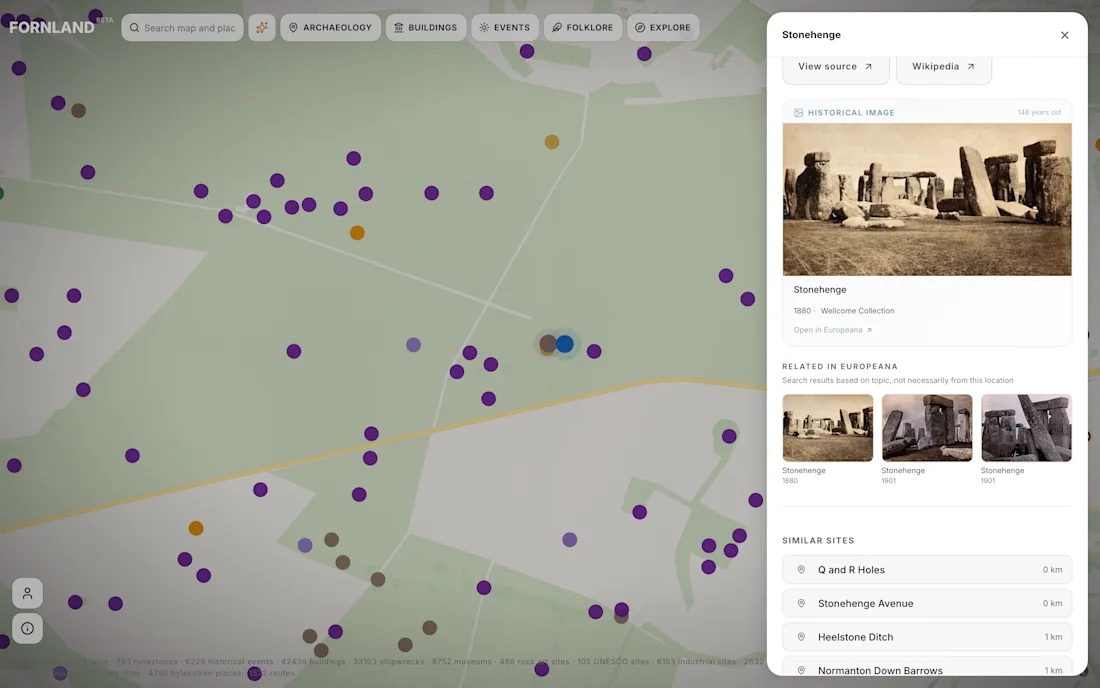
Fornland goes beyond cataloguing heritage sites. At its core is the idea that cultural heritage is deeply tied to place. By mapping locations geographically, the platform encourages users to experience history in relation to the landscapes around them: whether they are exploring nearby monuments, travelling through rural areas or rediscovering familiar places through a historical lens.
This spatial approach reflects a wider movement within digital cultural heritage towards contextual and connected discovery. Cultural heritage data becomes more meaningful when users can explore relationships between objects, places and stories, rather than encountering isolated records. Fornland supports this by suggesting other sites near the one the user has selected.
Fornland collects data on 1.6 million sites from over 16 sources, including Europeana. Specifically, the platform integrates with the Europeana Search API to display historical images, documents and artefacts for each site, encouraging deeper exploration. Over the course of a month, Fornland delivered Europeana content to users over seventeen thousand times, enabling them to contextualise cultural heritage data from the Nordic and Celtic world.
Gamification and personal contribution
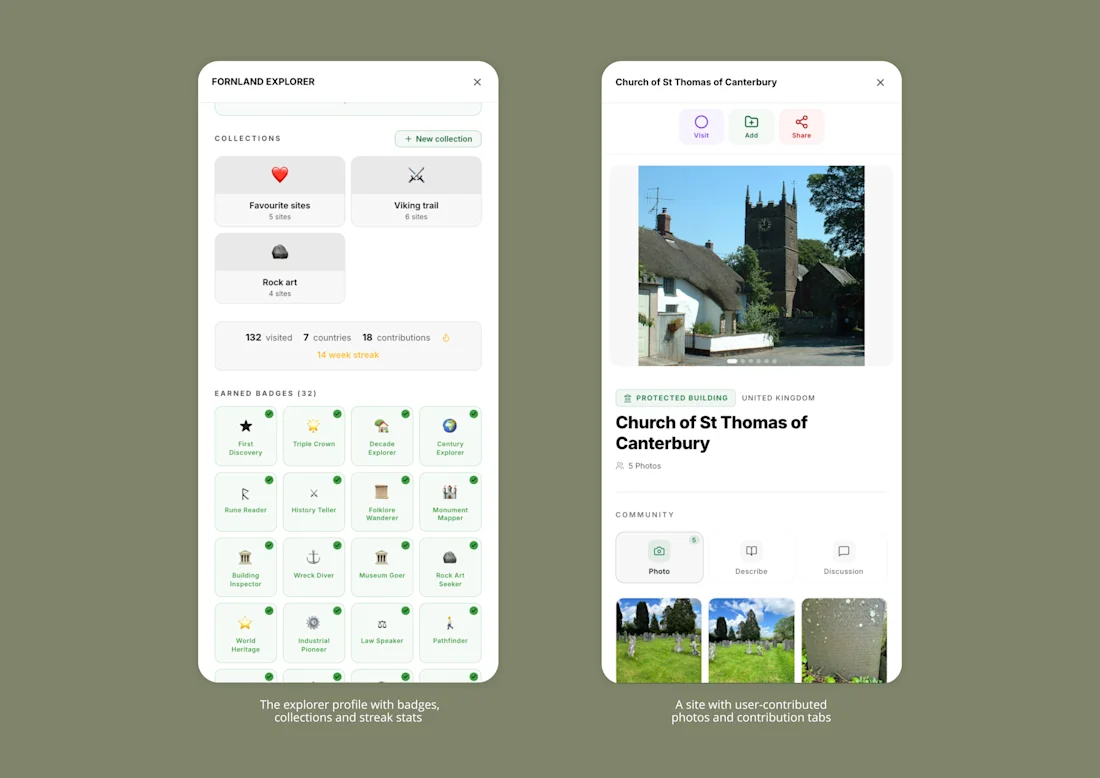
Fornland also highlights how participation can strengthen engagement with heritage. The platform includes gamified features such as badges and achievements that encourage exploration. These mechanics transform heritage discovery into an active experience, particularly for younger and digitally native audiences who are accustomed to interactive online environments.
Additionally, Fornland encourages participation through a collaborative dimension. Users can contribute comments, photographs and local knowledge directly to individual sites, allowing heritage records to grow over time through community participation. This creates space for lived experience and local storytelling alongside formal archaeological and historical information.
Such participatory approaches are becoming increasingly significant within the cultural heritage sector. Digital platforms are no longer only places where institutions publish information; they are becoming environments where communities can contribute context, interpretation and personal perspectives. In this way, projects like Fornland demonstrate how digital heritage can support both preservation and ongoing cultural exchange.
Reusing cultural heritage data
The success of specialised heritage applications demonstrates the value of accessible cultural heritage data. Europe’s vast collections of digitised cultural heritage material provide a rich foundation for developers, researchers and creatives to build new tools and experiences tailored to specific regions, communities and interests. From mapping projects and educational tools to creative reuse and tourism applications, the reuse potential of cultural heritage data continues to expand.
At a time when many people are searching for stronger connections to place and identity, projects like Fornland show how digital technology can help reconnect audiences with local histories embedded in the landscape around them. By combining mapping, gamification and personal contribution, the platform offers an example of how cultural heritage data can become not only accessible, but meaningful, social and alive.
Get involved
Are you interested in using Europeana’s APIs to integrate cultural heritage data into a tool or product? Find out more and get an API key.